.png&w=384&q=75&dpl=dpl_3xiX4GP1Zi6atjhU1DgAe8TnHk2Z)
*English Below「うまく働くために」シリーズ
うまく働くために:情報の流れ
新しい会社に入ったとき、海外に移住したとき、あるいは仕事で行き詰まりを感じたとき、良い仕事の基本原則を誰もきちんと説明してくれないことがあります。このシリーズは、そうした状況を変えるための試みです——チームの一員として、良い実践を積み重ねることでみんなが一緒に成長できるよう、基本をひとつひとつ丁寧に解説していきます。
すべては情報の流れである
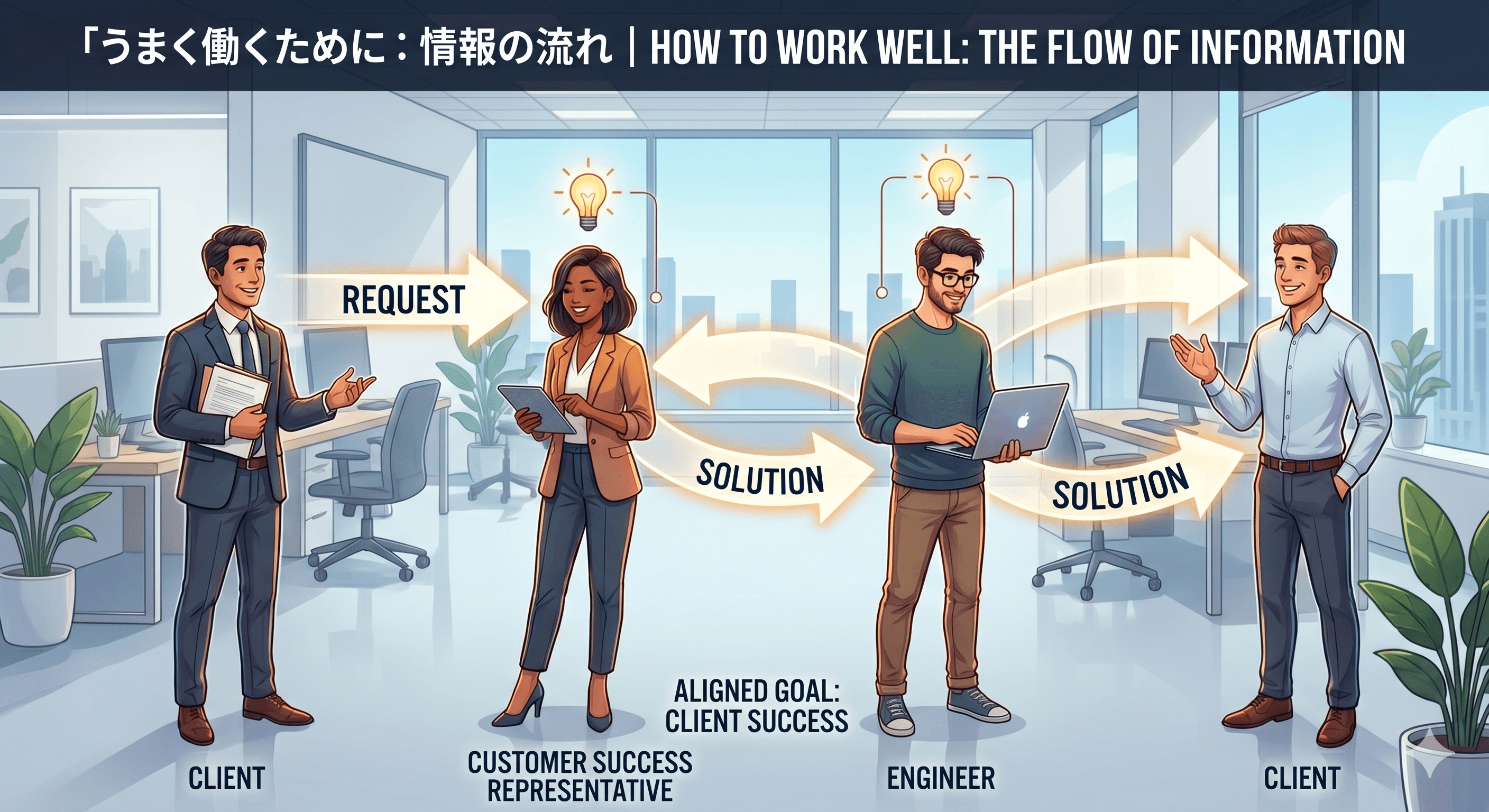
会社でどんな仕事をしていても、情報は常にある場所から別の場所へと流れています。多くの場合、情報はクライアントからやってきます。あなたはその情報を整理してチームに伝えます。チームはクライアントを満足させるために何かを実行します。そして今度はチームから情報を受け取り、それを整理してクライアントに返します。
あなたは常に、その流れのどこかに位置しています。
大きな企業では、最終ユーザーと実際の仕事の間に、10から15層ものコミュニケーションの階層が存在することもあります。ただし重要なのは、すべての階層を理解する必要はないということです。できれば理解するに越したことはありませんが、必須ではありません。自分の前の階層と、自分の後ろの階層だけを理解すれば十分です。
大切なのは「何を言うか」ではなく「どう受け取られるか」
これが核心です:大切なのは自分が何を言いたいかではなく、相手がそのコミュニケーションをどう受け取るかです。
実際の例を挙げましょう。先日、私たちのカスタマーサクセス担当がクライアントとのミーティングを終え、私のところに来て話してくれました。彼女が言ったこととは——「うちの会社はこれができます、あれはできません、この方向を目指しています」というものでした。
気持ちはわかります。会社への情熱があり、ビジネスを守ろうとしていたのです。しかし、コミュニケーションのアプローチとして、それは間違っていました。
クライアントに対して、自社がやりたいこと、自社がやっていること、自社の方向性だけを話すと——それは完全に自分たちの視点からの話になります。クライアントは話を聞いてもらえていないと感じます。自分のことを重要だと思われていないと感じます。
そして、クライアントが話を聞いてもらえていないと感じると、様子をうかがい始めます。少し大げさな要求をしたり、強く押してきたり、非常識に見える依頼をしたりします。それは相手が難しい人だからではなく、信頼関係が築かれていないからです。本当に味方でいてくれるのか、確かめようとしているのです。
共感が欠けると、連鎖は崩れる
共感が連鎖から欠けると、必ずこうなります。
カスタマーサクセス担当は、信頼不足の色がついたクライアントの要求を、エンジニアたちがどう受け取るかを考えずにそのまま渡してしまいました。エンジニアたちのコンテキスト、キャパシティ、感情的な状態を考慮しなかったのです。ただ要求を転送しただけでした。
エンジニアたちは、文脈なしに届いたときに多くの人がそうするように反応しました——「それは多すぎる、スコープ外だ、できない」と。
コミュニケーション全体が迷走しているように見えました。しかし、そうである必要はなかったのです。その連鎖にいたすべての人——担当者も、エンジニアも、クライアントでさえも——それぞれ自分の役割のことを考えていただけでした。悪意はありません。ただ自然に:自分の仕事をうまくやるにはどうすればいいか、どう実行すればいいか、と考えていただけです。
問題は、ほとんどの人が自分の仕事のことだけを考えているということです。そして、それがまさに連鎖が崩れるところです。
まずコンテキストから始める
誰かが情報を持ってきたとき、自分に問いかけてください:この人はどんなコンテキストから来ているのか、そしてそれを踏まえて、どう答えるべきか?
この人が次の会話に戻ったとき、本当に役立つ答えはどんなものか?これはフォーマルなコミュニケーションが必要な場面か、カジュアルでいいのか?スピードが必要か、丁寧さが必要か?この人が必要としているのは安心感か、明確な次のステップか?
目の前の人が何をしようとしているかを理解できれば、それに合わせてコミュニケーションを組み立てることができます。そして連鎖にいる全員が同じことをする——目の前の人を見て、信頼を得るにはどうすればいいか、正直に話してもらうにはどうすればいいか、簡潔に、同じ方向を向いてもらうにはどうすればいいかを考える——と、情報の流れ全体が変わります。
うまくいったときの姿
共感がすべての階層に組み込まれていたら、同じ状況がどう見えたかをお伝えします。
エンジニアは「できません」と言う代わりに、こう言えたはずです:クライアントが難しいことを求めているのはわかります。もう少し時間をもらえますか?追加リソースを要請できますか?新機能の開発をせずに進めるとしたら、クライアントはそれでも納得してくれますか?その場合、割引を提供するという選択肢はありますか?
これで、カスタマーサクセス担当はクライアントに持ち帰れる本物のもの——壁ではなく、選択肢——を手にできます。
そしてカスタマーサクセス担当は、会社を守ろうとするのではなく、次のクライアントとの会話をこう始められたはずです:何かを申し上げる前に、まだあなたの動機を100%理解できていないと思っています。私たちの会社を選んだ理由をもう少し教えていただけますか?私たちがあなたにとって最適な解決策だと思われる理由は何でしょうか?
クライアントが答えられないこともあります——それはそれで構いません。最初からミスアラインメントだったのかもしれません。しかしほとんどの場合、興味深いことが起こります:クライアント自身が理由を作り始めます。あなたのプロダクトを自分自身に売り込み始めるのです。一緒にいる理由を、信頼する理由を、前に進む理由を、自分で見つけていきます。
それがコミュニケーションの最高峰です。
まとめ
誰もが自分の視点を持っています。それは当然のことです。しかし良い仕事とは、誰が何を求めているかを見極め、言うべきことを相手にとって響く形で伝えることです。自分が言い切った満足感のためではなく。
そうするとき、会話は交渉から協力へと変わります。エンジニアも、クライアントも、営業も、サポートも——みんなが同じ船に乗れます。
そして、相手が自分自身の言葉と論理であなたと働くことを選ぶようになったとき——あなたは素晴らしいキャリアを歩み、私たちは長い時間をかけて一緒に成長していけます。
次回:うまく働くためのさらなる原則について。
How to Work Well Series
How to Work Well: The Flow of Information
Sometimes when you join a new company, move to a different country, or feel stuck at work, people don’t know how to explain to you what the core principles of good work practices actually are. This series is my attempt to lay it all out — so that as members of a team, we can all grow together by doing better work.
Everything Is a Flow of Information
Whatever you’re doing in a company, information always goes from one place to another. Most of the time, it comes from the client. You synthesize that information and pass it to your team. Your team executes something to make the client happy. Then you take what comes back from your team, organize it, and pass it back to the client.
You’re always somewhere in that line.
In big corporations, there can be ten to fifteen layers of communication between the final user and the work itself. And here’s the thing: you don’t need to understand every single layer. If you do, even better — but you don’t need to. You just need to understand the layer before you and the layer after you.
It’s Not What You Say — It’s How They Receive It
This is the core idea: it’s not what I want to say, it’s how the other person is going to receive that communication.
Let me give you a real example. Recently, someone on our customer success team had a meeting with a client. Afterward, they came to me and walked me through what they’d said — things like: our company can do this, our company can’t do that, our company is going in this direction.
I understood where they were coming from. They were passionate about the company and trying to protect the business. But the way they were approaching the communication was wrong.
When you talk to a client only about what your company wants, what your company does, what your company’s direction is — you’re talking entirely from your own perspective. The client feels unheard. They feel unimportant.
And when a client doesn’t feel heard, they start testing the waters. They ask for things that are a little over the top, push a little harder, make requests that seem unreasonable — not because they’re difficult, but because there’s no trust being built. They’re looking for signs that you’re actually there for them.
The Chain Breaks When Empathy Is Missing
What happened next is what always happens when empathy is missing from the chain.
The customer success rep took those client requests — already colored by a lack of trust — and brought them to the engineers without considering how the engineers would receive them. She didn’t filter for their context, their capacity, or their emotional state. She just passed the requests along.
The engineers heard the requests and responded the way most people would when something lands out of context: that’s too much, that’s out of scope, we can’t do that.
The whole communication felt like a lost cause. But it didn’t have to be. Every person in that chain — the rep, the engineers, even the client — was just thinking about their own role. Not in a bad way. Just naturally: how do I do my job well? How do I execute this?
The problem is that most people are thinking about their own job. And that’s exactly where the breakdown happens.
Start With Context
When someone brings you information, ask yourself: what is the context this person is coming from, and based on that, how should I respond?
Which kind of answers will actually help them when they go back to their next conversation? Is this a moment for formal communication or casual? Fast or slow? Does this person need reassurance, or do they need clear next steps?
If you understand what the person in front of you is trying to do, you can organize your communication around that. And if everyone in the chain does the same thing — looks at the person in front of them and asks how to get them to trust, to be honest, to be concise, to be aligned — the whole flow of information changes.
What It Looks Like When It Works
Here’s what that same situation could have looked like if empathy was built into every layer.
The engineer, instead of saying “we can’t do that,” could have said: I understand the client is asking for something difficult. Can we ask for more time? Can we ask for extra resources? Is there a way to offer a discount so we can move forward without the new features? Would the client be open to that?
Now the customer success rep has something real to bring back — options, not walls.
And the customer success rep, instead of defending the company, could have opened the next client conversation with: Before I say anything, I don’t think I fully understand your motivations yet. Can you tell me more about why you came to us? Why do you think we might be the right solution for you?
Sometimes the client won’t have a good answer — and that’s okay. It might have been a misalignment from the start. But most of the time, you’ll see something interesting happen: the client starts building the case themselves. They start selling your product to themselves. They find the reasons to stay, to trust, to move forward.
That is the highest level of communication.
The Summary
Everyone has their own perspective. That’s normal. But good work means looking at who is asking you something and why — and finding a way to say what needs to be said so that it lands well for them, not just feels complete for you.
When you do that, conversations stop feeling like negotiations and start feeling like collaborations. Engineers, clients, sales, support — everyone ends up in the same boat.
And if you can get people to sell themselves on working with you, through their own words and their own reasoning — you’re going to have a great career, and we’re going to be working together for a long time.
Next in the series: more principles on how to work well.

AUTHOR
Gustavo Dore ドリー
Tech Crew CEO
.png&w=3840&q=75)